
A tiled shower is only as strong as its joints. Every grout line is a seam that has to be sealed, cleaned and kept sound for years. Large-format slabs change that math. Instead of hundreds of small pieces, a wall can be covered with a few full sheets, so there are fewer seams to fail and far more of the material's pattern on show.
At Artifex Reno, large-format slabs are moved with vacuum lifters and set by hand as full sheets. Here is what that work involves, why it suits a shower, and what it looked like on a recent bathroom.
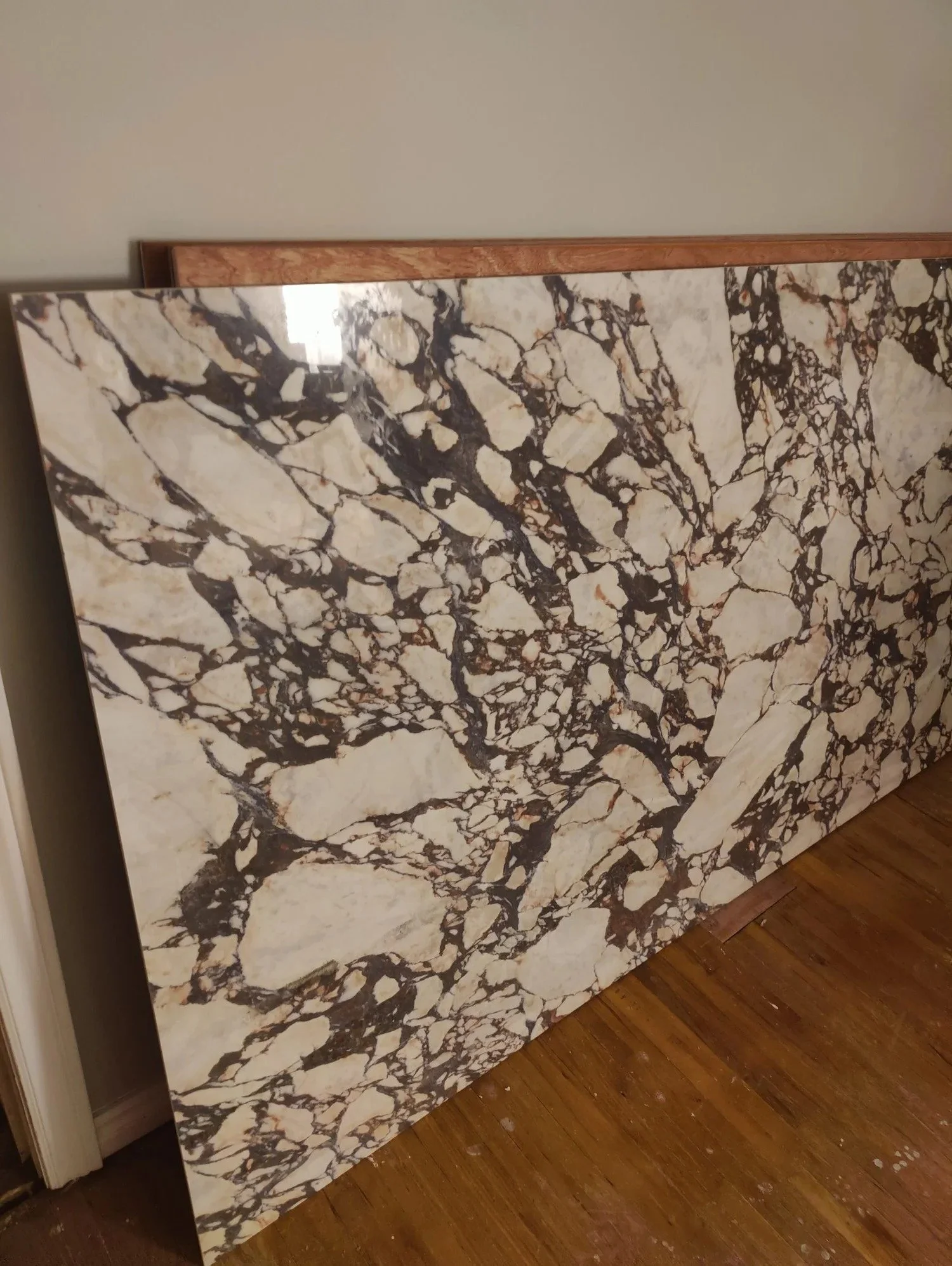
What counts as a large-format slab
Most bathroom tile is small enough for one person to carry and set with one hand. A large-format slab is a different object: a full sheet, often taller than a person, meant to cover a wall or a bench with as few pieces as possible.
That size is the whole point. A slab wall reads as one surface, the veining runs uninterrupted, and the only joints are where one sheet meets the next or meets a corner.
Why fewer seams matter in a shower
Water finds its way into weak points. In a shower, those weak points are joints. Fewer joints means less grout to stain, less to clean and less that can crack over time. As our homepage puts it: fewer seams, no grout lines to fail.
A slab is still only the finished face. The waterproofing behind it does the real work, and it has to be done properly before any sheet goes up. We covered that stage in what proper bathroom waterproofing looks like before the tile goes on.
Cutting a full sheet
A slab leaves very little room for error. Each sheet is cut to its final size and shape before it is set, and a bad cut on a large piece cannot be hidden in a grout line.
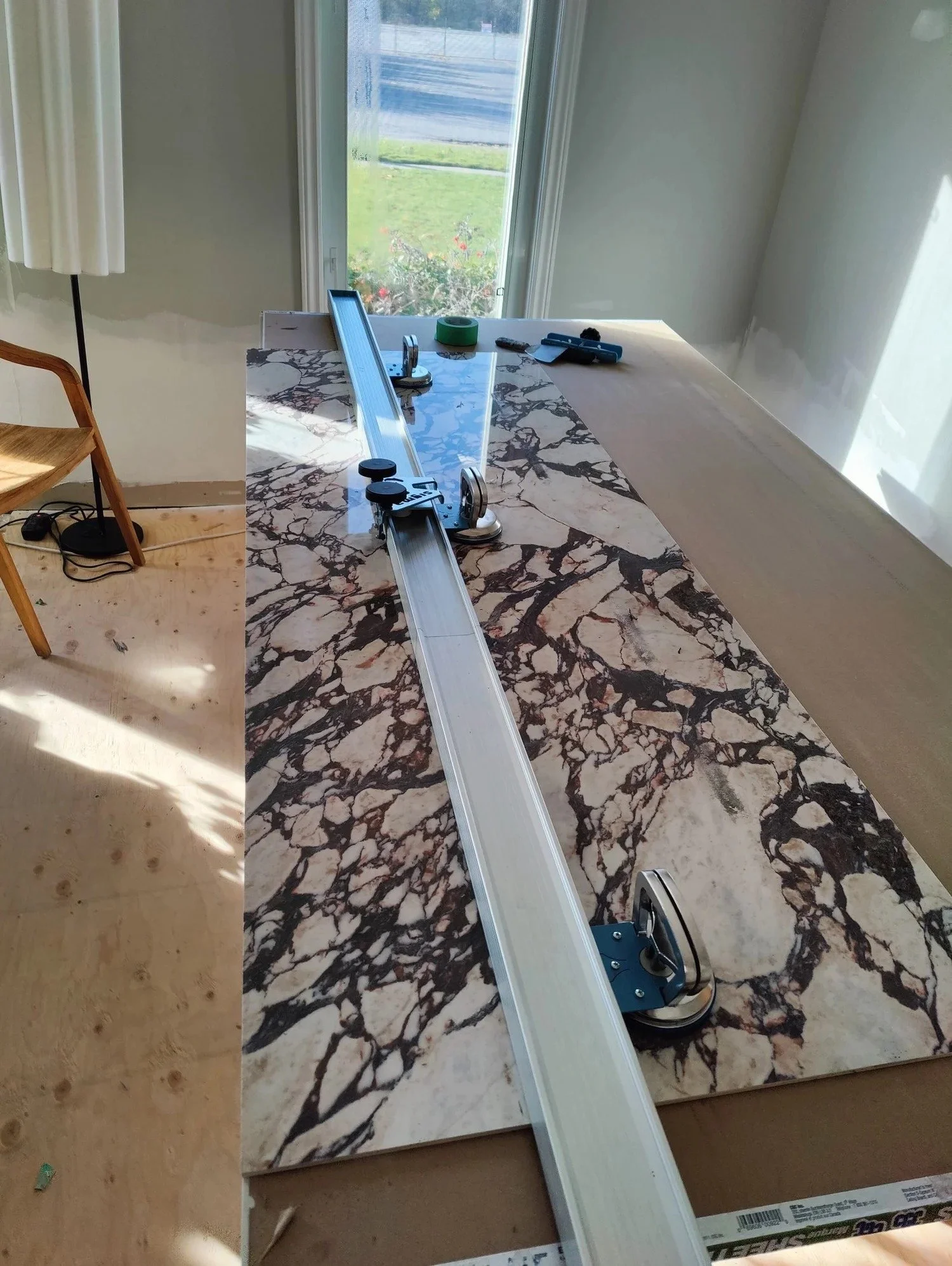
On this job, the slab was laid flat on a work table and cut along a long guide rail with a track saw, which keeps a straight line across the full length of the sheet. Planning the cuts also decides where the strongest veining lands on the wall, so the pattern looks placed, not random.
Moving and setting by hand
Full sheets are heavy and can crack if they flex. That is why they are moved with vacuum lifters, which grip the face of the slab so it can be carried and positioned under control. Each sheet is then set by hand against a flat, prepared wall.
Flatness matters even more with a slab than with small tile. A long sheet has nowhere to hide a dip or a bow in the wall behind it, and any edge sitting proud of the next is easy to see. The same thinking behind our post on tile leveling and lippage applies here, just at a larger scale.
Slab and tile together
A shower does not have to be all slab. On this bathroom, the veined slab covers a full wall and wraps the shower bench, while the back and side walls are set in a herringbone tile with a full-width niche. The slab gives the room its statement, and the smaller tile adds texture around it.
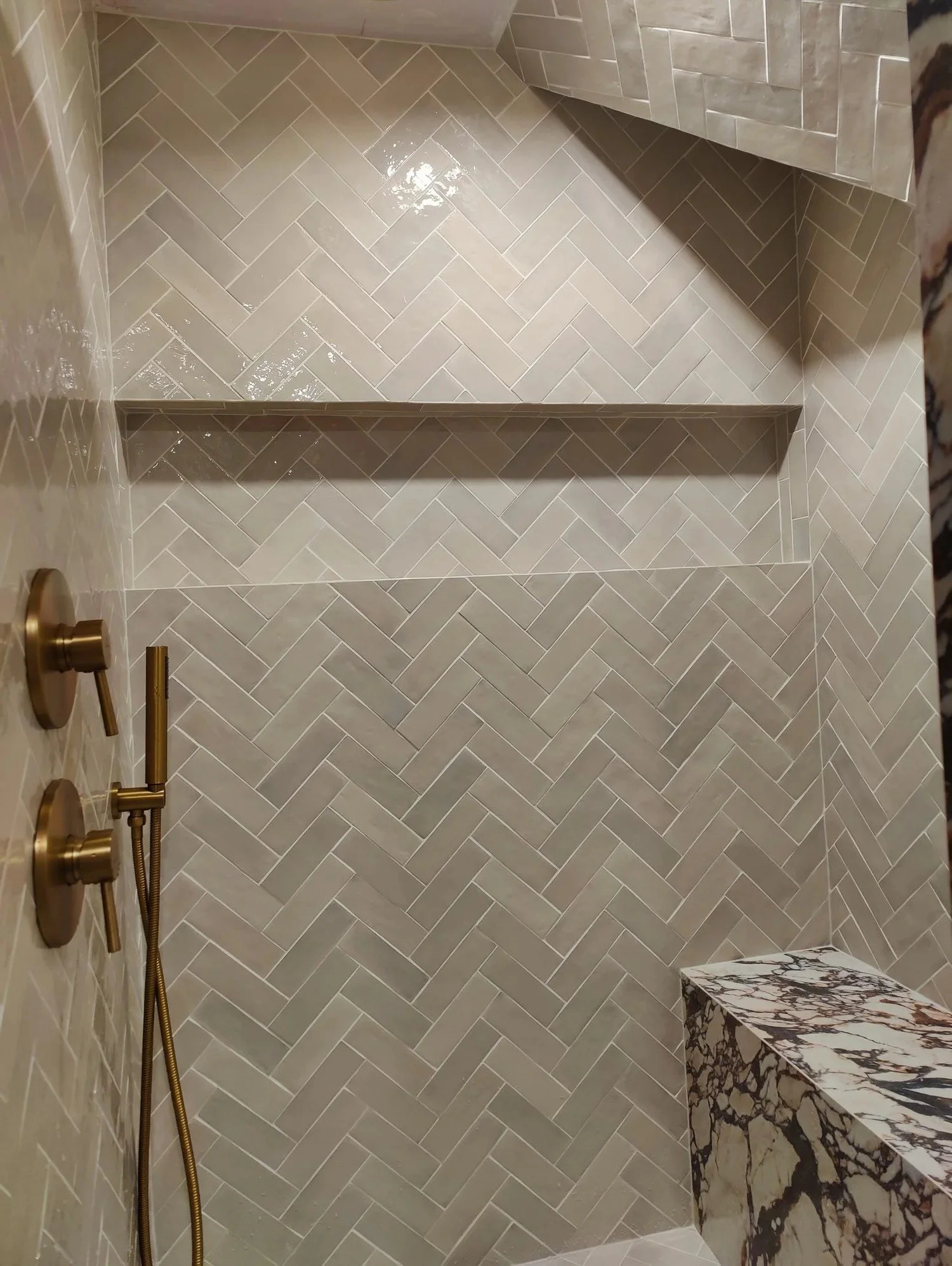
A slab bench is a good example of where full sheets shine. Wrapping a bench in a few large pieces gives clean edges and very few joints on a surface that is sat on, splashed and wiped every day.
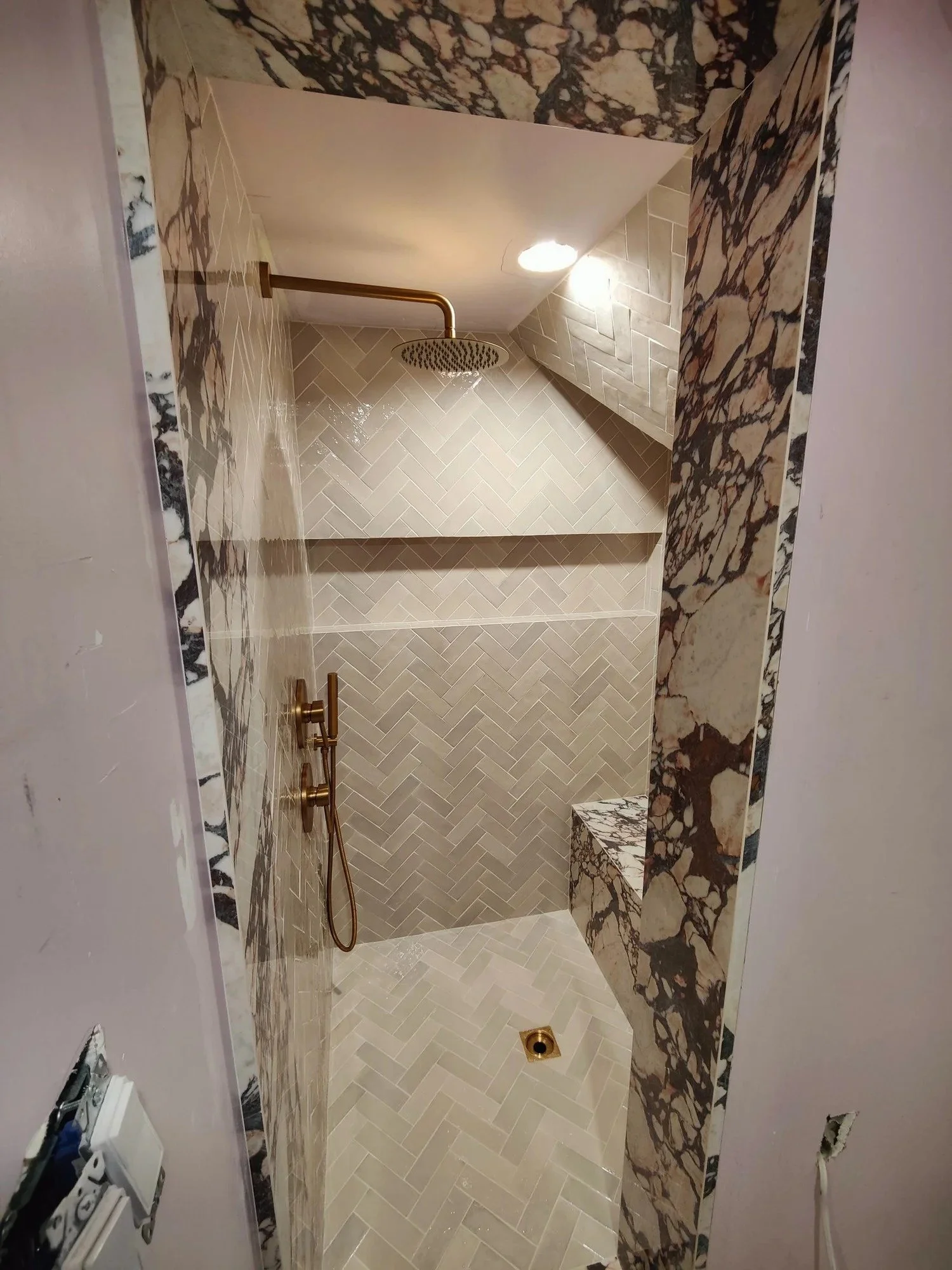
What the finished shower shows
The finished room pairs a veined slab wall and slab bench with herringbone wall tile, a long recessed niche, a ceiling-mounted rain head and brushed brass controls with a handheld shower.
What to ask before you choose slabs
- How will the sheets be moved and set without flexing or cracking?
- How is the wall checked for flatness before a sheet goes up?
- Where will the joints fall, and where will the strongest veining land?
- What waterproofing goes behind the slab?
- Will the price be fixed in writing before work starts?
FAQ
What is a large-format slab? It is a full sheet of material, much larger than standard tile, used to cover a wall, bench or floor with as few pieces as possible.
Are slabs better than tile in a shower? They are not better in every case, but they mean fewer seams and fewer grout lines to clean and maintain. Many showers combine both, as this one does.
Do slabs replace waterproofing? No. The slab is the finished surface. A full waterproofing system still goes behind it.
Can a slab be used for a shower bench? Yes. Wrapping a bench in slab gives clean edges and very few joints on a surface that gets daily use.
How is the price set? After a walkthrough, you get a fixed written scope covering materials, timeline and price. The number you approve is what you pay.
Planning a shower in Toronto or Mississauga?
Nazar will visit, look at the space and give you a fixed written scope. See more of our bathroom renovation work and projects, get in touch or call or text +1 647 223 4051.
